
We're launching two new stational trainings for refrigerated transport — on the ATP Agreement and on Good Distribution Practice (GDP). Find out who they're for and how to register.
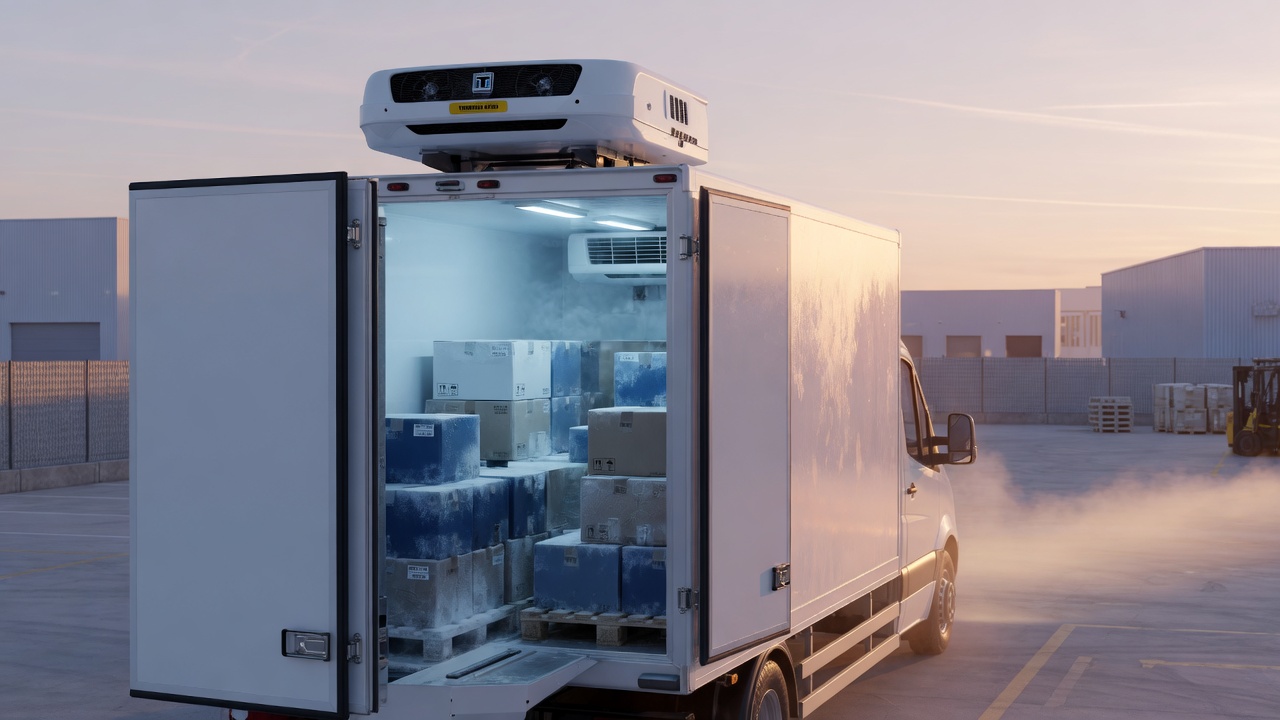
Keeping a courier's cold box at a stable 0–4°C while its doors open and close dozens of times a day is physically much harder than it sounds. Every opening triggers a rapid exchange of air masses, the refrigeration unit has thermal inertia and can't instantly re-cool the interior, and frost builds up on the evaporator, cutting into system capacity. As a result, the cold chain is most vulnerable at exactly the moments that seem least significant.
That's why we're glad to announce that the Central Refrigeration Center COCH in Kraków has expanded its training offer with two new dedicated stational courses, addressing the real-world challenges faced by transport companies, logistics operators, and manufacturers of refrigerated means of transport.
ATP Agreement Training for Refrigerated Transport
The first of the new courses — ATP Agreement for Refrigerated Transport — prepares participants to correctly classify, test, and document the conformity of vehicles carrying perishable foodstuffs. The program covers:
ATP Agreement requirements for thermally insulated, refrigerated, and mechanically refrigerated bodies,
classification and marking of means of transport in accordance with the Agreement's annexes,
hands-on workshops on completing conformity declarations — separately for the insulated body and for the refrigeration/heating unit.
The training is led by specialists from the COCH accredited ATP laboratory (PCA AB 308), who run ATP tests and issue ATP certificates for manufacturers across Europe on a daily basis.
Good Distribution Practice (GDP) Training
The second course — Good Distribution Practice (GDP) in Refrigerated Transport — combines two perspectives: management (for logistics staff and fleet managers) and operational (for couriers and drivers). Participants learn:
a methodology for mapping temperature distribution and identifying critical points in the cargo space,
how to build CAPA procedures (corrective and preventive actions) and assess the risk of cargo loss,
practical operational procedures — correct loading and unloading, how to respond to unit failures, and rules for opening refrigerated compartment doors.
This is exactly where participants learn why keeping a stable temperature with frequent door openings is so technically difficult — and which specific operational habits minimize the risk of a cold chain break.
Who are these trainings for?
Both courses are aimed at manufacturers of insulated bodies and refrigeration/heating units, logistics and fleet managers, transport and courier companies, quality and compliance departments, and pharmaceutical and food manufacturers responsible for the compliance of their product distribution.
How to register
Both trainings are one-day stational courses at the COCH headquarters in Kraków, ul. Juliusza Lea 116, ending with a summary test and an official COCH certificate. The price includes proprietary training materials, full catering, and free parking at the center.
Register today through our registration page or email us directly at szkolenia@coch.pl — we're happy to answer any questions about the program and available dates.
COCH offer
GDP certificate for pharmaceutical transport
Accredited GDP certification of vehicles, containers and chambers.
Rate this article
Be the first to rate this article!


