We are expanding our scope of accredited testing. Since November 2021 we have held extended accreditation from the Polish Centre for Accreditation (PCA) No. AB 308.
New accredited testing at COCH
We are pleased to inform you that we are expanding the scope of accredited testing we conduct. Since November 2021 we have held extended accreditation from the Polish Centre for Accreditation (PCA) No. AB 308, the full scope of which you can review on the page and under this link. The most important new tests covered by accreditation, by which we have broadened our activity, are summarised below:1. Testing of insulated containers for transport of temperature-sensitive goods:

 In addition to continuing accredited testing of means of transport used for distribution of pharmaceutical products (for human or veterinary use in accordance with GDP requirements) and thermally insulated road transport means intended for the carriage of perishable foodstuffs (for the purpose of obtaining an ATP certificate), we will (as the only laboratory in Poland) carry out accredited testing of: insulated containers for road, rail and sea transport of cargo that enable transfers between the above different modes of transport in accordance with PN-EN 1496-2:2020-10; insulated containers for transport of temperature-sensitive goods in accordance with PN-EN 17066-1:2019-10.
 A refrigerated container is a mobile store capable of storing goods requiring a defined temperature and humidity, finding application in various modes of transport, of which the most popular are sea and rail transport. These containers have the ability to control, among other things, temperature and humidity, enabling carriage of temperature-sensitive goods to every corner of the world. Our offer of refrigerated container testing is our response to the growing logistical demand for these units. New refrigerated containers should meet the requirements of the ATP Agreement.
2. Acoustic and noise testing, including noise caused by vibration of machines and equipment:


Acoustic testing complements our offer of comprehensive testing of refrigeration equipment and heat pumps (including testing for the European quality mark KEYMARK). Thanks to professional acoustic testing equipment we are able to measure A-weighted sound pressure level (in the range 30–136 dB) and calculate A-weighted sound power level under selected measurement conditions specified in standards PN-EN 12102-1:2018-03 (as the only laboratory in Poland), PN-EN 12102-2:2019-06 (as the only laboratory in Poland), PN-EN ISO 3744:2011 and PN-EN ISO 3746:2011.
Accredited testing covers measurements for equipment such as: air conditioners, liquid chillers, heat pumps, process chillers and dehumidifiers with electrically driven compressors, heat pump water heaters, and other machines and equipment.
We are also open to testing other equipment not covered by the scope of our accreditation.
3. Fan testing taking into account Ecodesign requirements:


The extended scope of accredited testing for fans now also takes into account so-called Ecodesign rules. Ecodesign requirements for industrial fans are mandatory for all manufacturers and suppliers wishing to sell their products in the EU. These requirements cover product information and efficiency. Ecodesign rules are driven primarily by concern for the natural environment and climate.
Using more efficient industrial fans can help reduce electricity demand and increase energy efficiency. Actual fan efficiency depends on its power demand (high-power fans are generally more efficient than low-power fans) and type. Choosing high-efficiency equipment allows average savings of about 20% of operating costs over the entire service life (15 years) compared with low-efficiency equipment.
For fans, the provisions of Commission Regulation (EU) No 327/2011 of 30 March 2011 are important. Equipment meeting the requirements of that Regulation should have a number of essential items of information specified, such as measurement category, efficiency category and efficiency ratio at the optimum energy efficiency point.
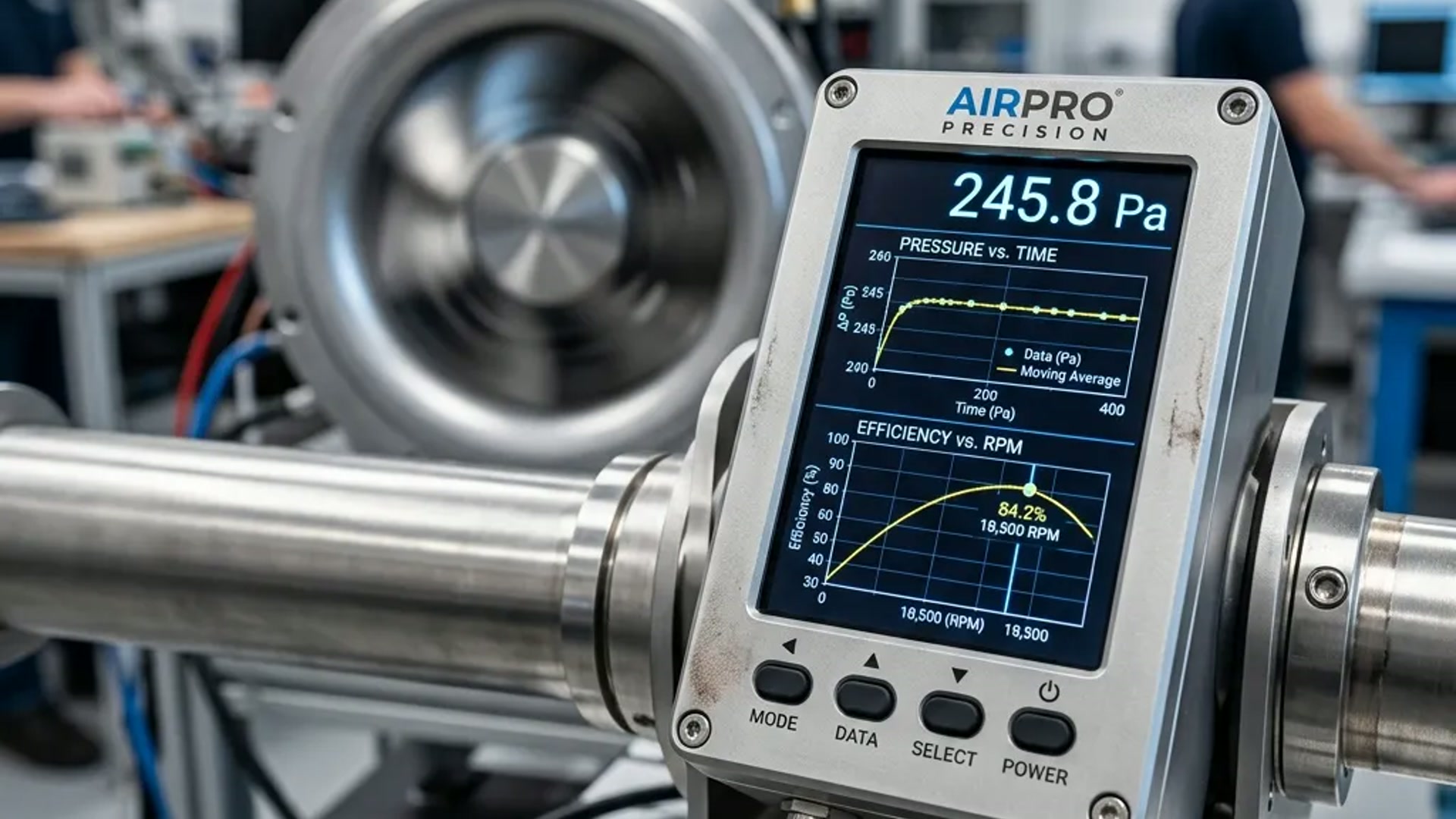
As part of the accredited testing conducted by our laboratory we determine capacity, equipment efficiency, power input and fan pressure.
We are the only laboratory in Poland with accreditation for fan testing in accordance with PN-EN ISO 5801:2017-12 and ANSI/AMCA 210-07, ANSI/ASHRAE 51-07.
4. Electrical safety testing of household and similar electrical appliances: heat pumps, air conditioners, dehumidifiers and refrigerated furniture
These tests complement the testing offer for equipment such as:
- electric heat pumps, air conditioners and dehumidifiers
- commercial refrigerating appliances with an integral or remote condenser or compressor (so-called refrigerated furniture)
These tests focus on determining and assessing equipment features in order to classify it as safe for use. They include tests checking equipment operation under controlled conditions and under abnormal conditions with overload of the compressor and fan motors and of electrical circuits. In addition, assessment covers, among other things, mechanical strength, resistance to high temperature, use of components, and correctness of protective earthing connections.
5. Refrigerated furniture – expansion of the offer to include testing of household and similar and professional refrigerating appliances, ice-cream machines, freezers and chillers


We have expanded our refrigerated furniture testing offer by a further five standards (as the only laboratory in Poland), covering testing of the following equipment:
- Professional refrigerated cabinets and counters (PN-EN ISO 22041)
- Household refrigerating appliances (PN-EN 62552)
- Ice-cream freezers (ISO 22043)
- Professional blast chillers and freezers (ISO 22042)
- Ice-cream machines (PN-EN 16764)
Testing of this equipment primarily covers determination of refrigerating system capacity, determination of energy consumption and a temperature test. The requirements, conditions and test methods for this equipment are described in the above standards.
Rising ecological and economic requirements, tightening regulations, and strong international and domestic competition are driving interest in testing this equipment in order to meet energy labelling requirements for refrigerating appliances.
Detailed guidelines on energy labelling of refrigerating appliances with a direct sales function are set out in Commission Delegated Regulation (EU) 2019/2018 of 11 March 2019 supplementing Regulation (EU) 2017/1369 of the European Parliament and of the Council. Commission Delegated Regulation (EU) 2015/1094 of 5 May 2015 supplements Directive 2010/30/EU of the European Parliament and of the Council with regard to energy labelling of professional refrigerated storage cabinets.
6. Refrigerating systems and heat pumps:


We have supplemented our standard offer of assessment of refrigerating systems and heat pumps in terms of safety and environmental protection with testing of the conformity of vessels and piping with regard to system leak tightness and strength by means of a pressure measurement method.
Requirements for stationary pressure vessels intended for use in refrigerating systems and heat pumps are governed by PN-EN 14276-1:2020-07. Testing applies both to vessels, including welded or brazed additions, including flange outlet ends, screwed, welded or brazed connections, and to the edge intended for welding or brazing at the first circumferential connection joining pipelines or other components.
Requirements for pipelines intended for use in refrigerating systems and heat pumps and intermediate cooling or heating systems, concerning material, design, manufacture, testing and documentation for stationary installations, are set out in PN-EN 14276-2:2020-07.
7. Accredited testing of air dehumidifiers according to PN-EN 810


In addition to accredited electrical safety testing and acoustic testing of this equipment, dehumidification capacity and energy consumption testing of air dehumidifiers with electrically driven compressors will also be performed at the COCH laboratory as accredited tests.
Dehumidifiers built as self-contained and portable units are particularly suitable for applications where dehumidifying premises as part of permanent air-conditioning installations is uneconomical or impossible. Self-contained portable units are used mainly in construction technology to accelerate the drying of rooms by reducing the relative humidity of air in a closed space. These units are commonly known as condensing compressor air dehumidifiers.
8. Testing of rooftop air conditioners:


Testing in accordance with EN 17625:2021-01 covers rooftop units providing space heating and/or cooling for comfort applications, of the air-to-air type as well as water (brine)-to-air units, driven by an electric compressor (or compressors), which may be equipped with an additional electric heater or fossil fuel combustion. Accredited testing also covers rooftop units with functions such as free cooling and heat recovery.
During testing, among other things, SEER and SEERon values, SCOP, SCOPon and SCOPnet efficiency coefficients under part-load conditions for determination of seasonal energy efficiency ηs,c and ηs,h, capacity values, EER and COP in active mode under part-load conditions, and power input in inactive modes (thermostat off, standby, off mode and crankcase heater mode) are determined.
Keywords:
Compressors, Cooling, Refrigerating equipment, Definitions, Fans, Heat exchangers, Heat pumps, Heaters, Liquid pumps, Measurements, Capacity, Refrigeration, Coolers, Roofs, Space heating systems, Testing, Fans, EcoDesign, Ecodesign, Acoustic testing, vibration,
References:
Rate this article
Be the first to rate this article!