
Detailed information on the International Agreement on the Carriage of Perishable Foodstuffs and on the Special Equipment to be Used for such Carriage (ATP).
 AB 308
 ILAC MRA
Agreement on the International Carriage of Perishable Foodstuffs and on the Special Equipment to be Used for such Carriage (ATP), concluded in Geneva on 1 September 1970. Poland has been a signatory to the ATP Agreement since 1984.
The ATP Agreement and its annexes are regularly updated by the Working Party on the Transport of Perishable Foodstuffs (WP.11) of the United Nations Economic Commission for Europe (UNECE). The rules define conditions for transport equipment, testing standards, marking rules and temperatures for foodstuffs. Application of ATP provisions is mandatory for all frozen products and certain chilled products.
Poland strives to maintain the highest quality of transported food and develop international trade through strict compliance with WP.11 standards.

Primary legal texts and UNECE materials for the ATP Agreement.
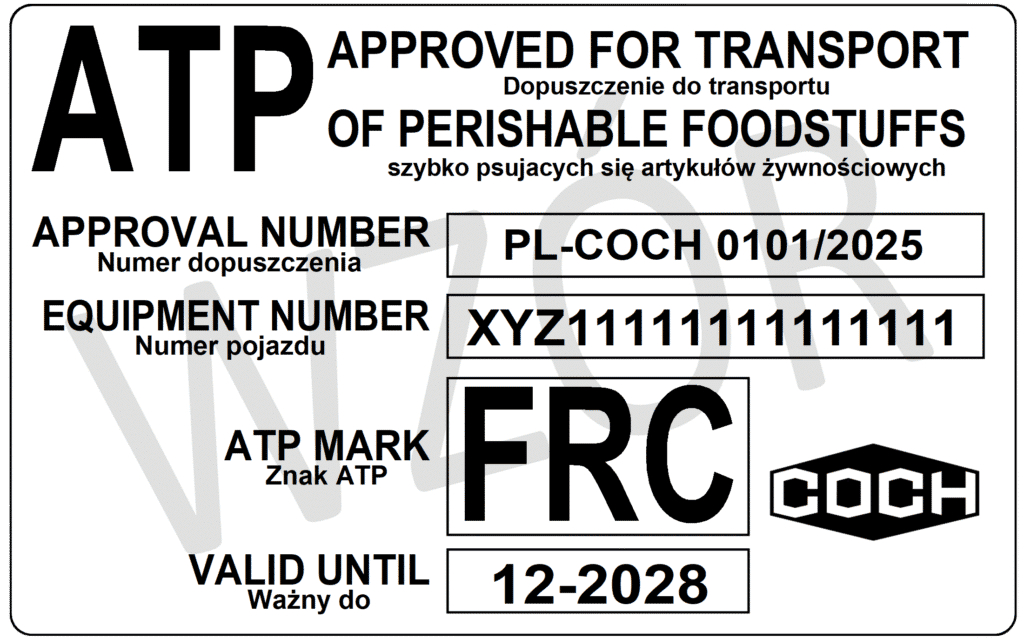
ATP certification plate pattern placed on transport equipment (Plate version 2)
The ATP certification plate should be permanently attached to the vehicle. It contains the certificate number, expiry date, and vehicle class designation. Transport equipment approved for food carriage must have a permanent manufacturer’s plate and an ATP certification plate confirming compliance with the agreement requirements.
An ATP certificate is a document confirming that a vehicle intended for the carriage of perishable foodstuffs meets the technical requirements specified in the ATP Agreement. This document specifically applies to insulated, refrigerated, and heated vehicles used in international transport.
The ATP Agreement is an international convention aimed at ensuring appropriate standards in the transport of perishable goods. It was adopted in 1970 under the auspices of the United Nations Economic Commission for Europe (UNECE).
To obtain an ATP certificate, the vehicle must undergo technical tests performed at accredited testing stations. During these tests, the following are checked:
A new vehicle receives a certificate valid for 6 years.
After 3 years, a periodic inspection is required.
After 6 years from the issuance of the original certificate, the vehicle must undergo a full technical test to obtain a new certificate.
Regular technical inspections of the body and cooling/heating systems are crucial to maintain the validity of the document.
The ATP certificate is valid in all countries that have signed the ATP Convention, including most European countries and some non-European countries such as Russia or China.
COCH is an accredited body for performing tests compliant with the ATP Agreement and issuing certificates for vehicles intended for the international carriage of perishable foodstuffs.
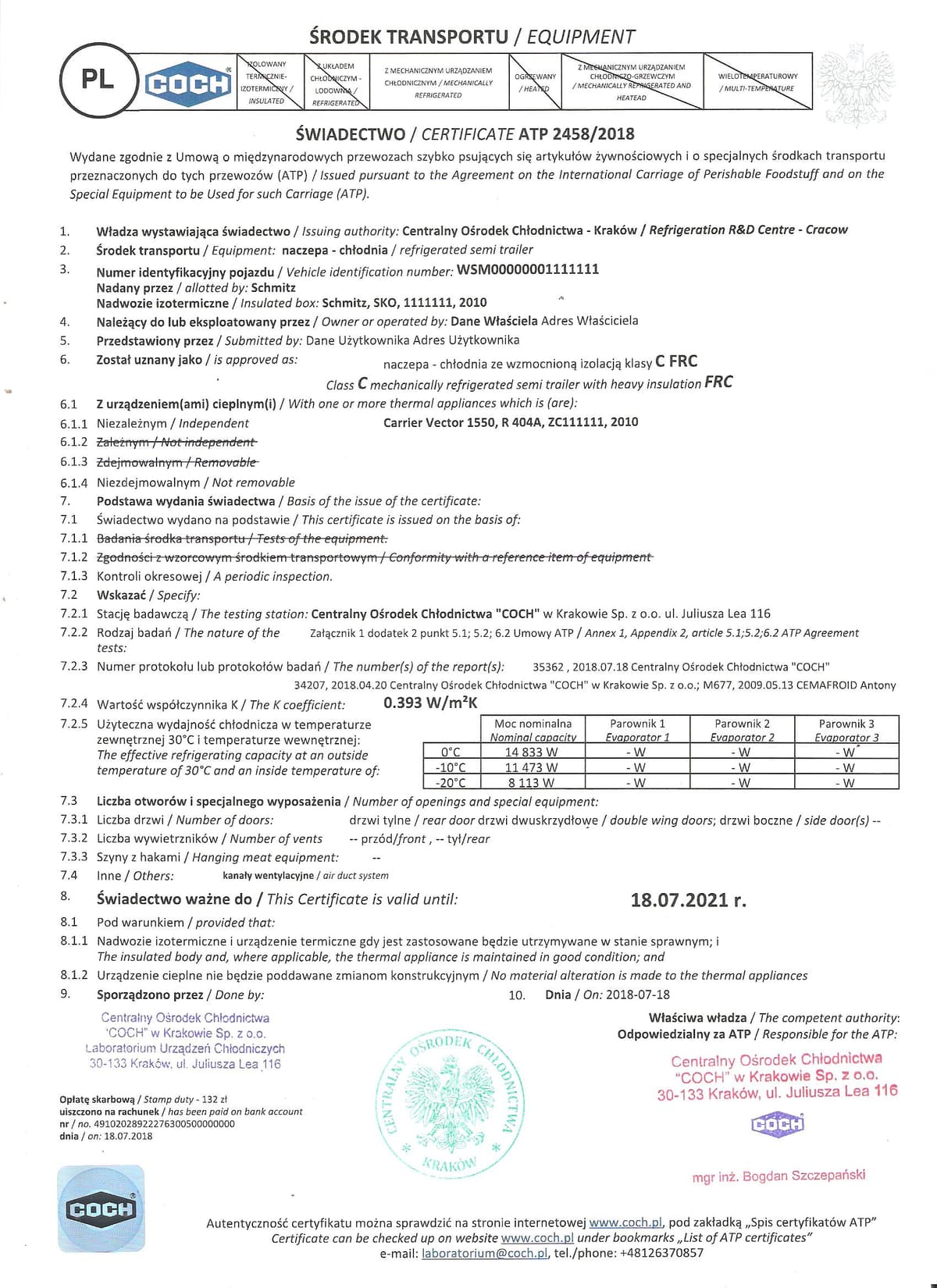
Transport equipment is classified according to its purpose, equipment, and the heat transfer coefficient “K”.
A÷F (for refrigerated), A÷D (for mechanically refrigerated/heated), A÷L (for refrigerated-heated)
Signifies a removable or dependent thermal appliance.
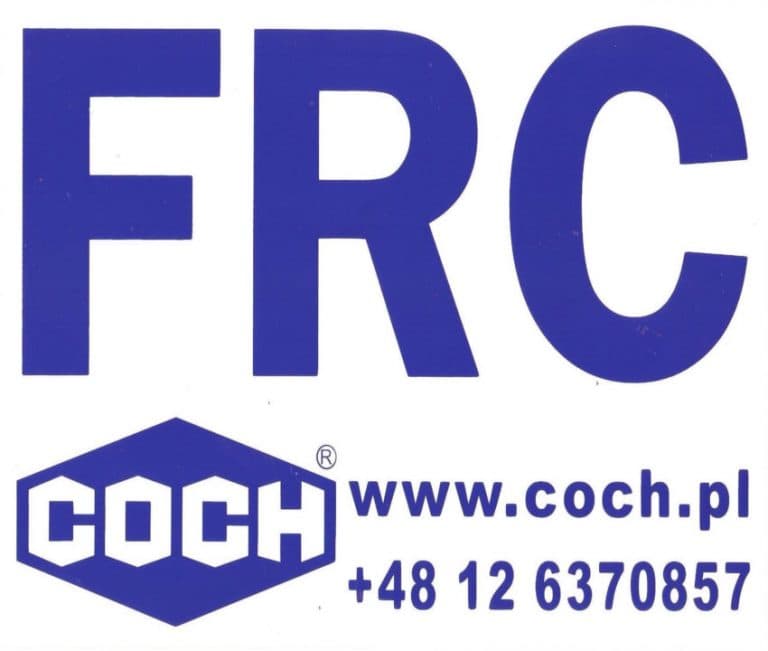
The ATP identification mark consists of dark blue letters on a white background. The ATP test marking should be located in the upper front corners of the insulated transport equipment.
The height of the letters should be at least 100 mm for the classification mark and at least 50 mm for the expiry date.
For smaller transport means with a total mass not exceeding 3.5 tonnes, the height of the classification mark letters may be reduced to 50 mm and to 25 mm for the test expiry date.
The identification mark must be removed as soon as the transport equipment ceases to meet the requirements of the ATP Agreement.
The data provided on the ATP marking must match the specification of the associated ATP certificate.
Vehicle side
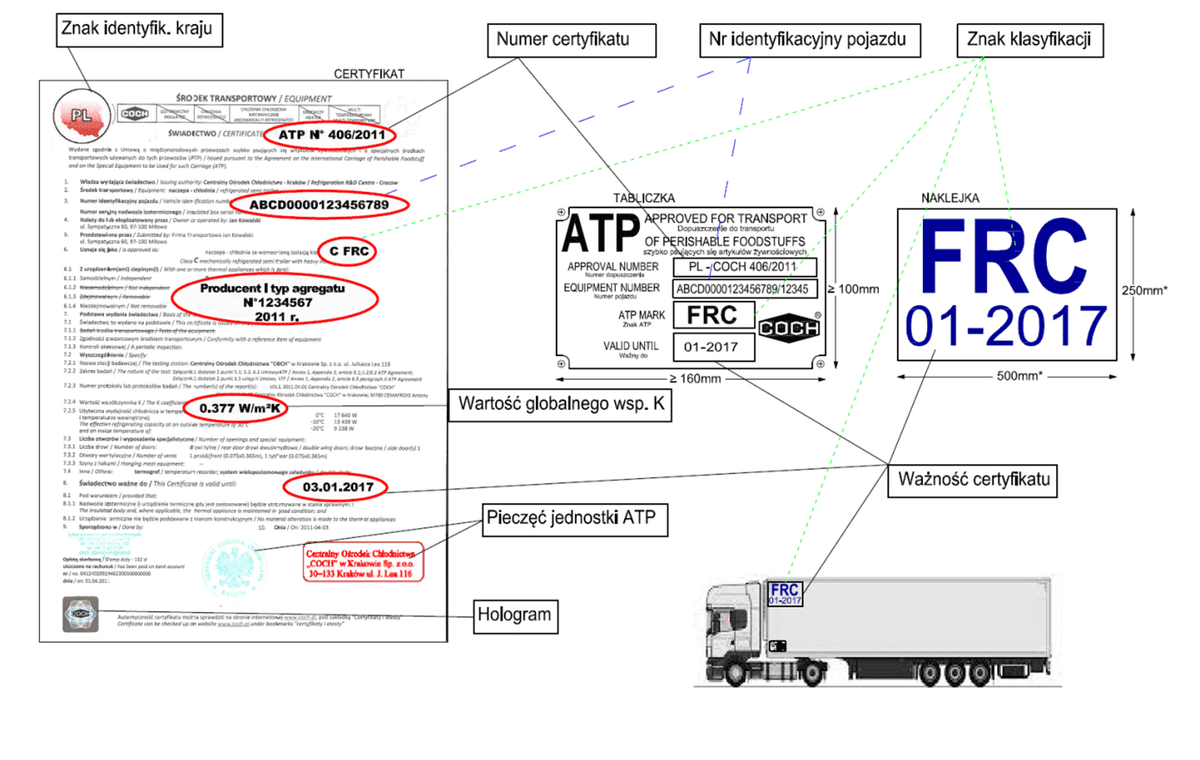
Layout
Required regularly: 6 years from the date of manufacture, then every 3 years. The test includes the efficiency of the cooling unit, insulation condition, door seals, and thermostat operation. In Poland, tests are performed by, among others, the Central Refrigeration Centre (COCH).
The inspection covers the efficiency of the refrigeration unit, insulation condition, door seals, and thermostat operation.
New transport equipment receives a certificate for a period of 6 years from the date of body manufacture.
After 6 years, each subsequent periodic inspection extends the certificate validity by another 3 years.
In Poland, tests are performed by, among others, the Central Refrigeration Centre (COCH) in Kraków, providing full PCA accreditation.
The ATP Agreement specifies maximum temperatures during transport for various product groups.
| Product | Max temp. |
| Raw milk | +6°C |
| Red meat and large game | +7°C |
| Dairy products, yogurt, butter, pasteurised milk, raw vegetables | +6°C |
| Small game, poultry, rabbits | +4°C |
| Red offal | +3°C |
| Minced meat | +2°C |
| Unprocessed fish, molluscs, crustaceans | On melting ice |
| Product | Max temp. |
| Butter | −10°C |
| All frozen products (except butter) | −12°C |
| Frozen fish, deep-frozen products | −18°C |
| Ice cream | −20°C |
Regardless of legal requirements, maintaining proper temperatures guarantees the quality and nutritional value of products and protects against financial losses due to complaints.
Currently, over 50 countries are parties to the ATP Agreement (as of 2018):
* The list includes states that acceded to the agreement by 2018. The current status of ratifications can be checked in the UN treaty database.
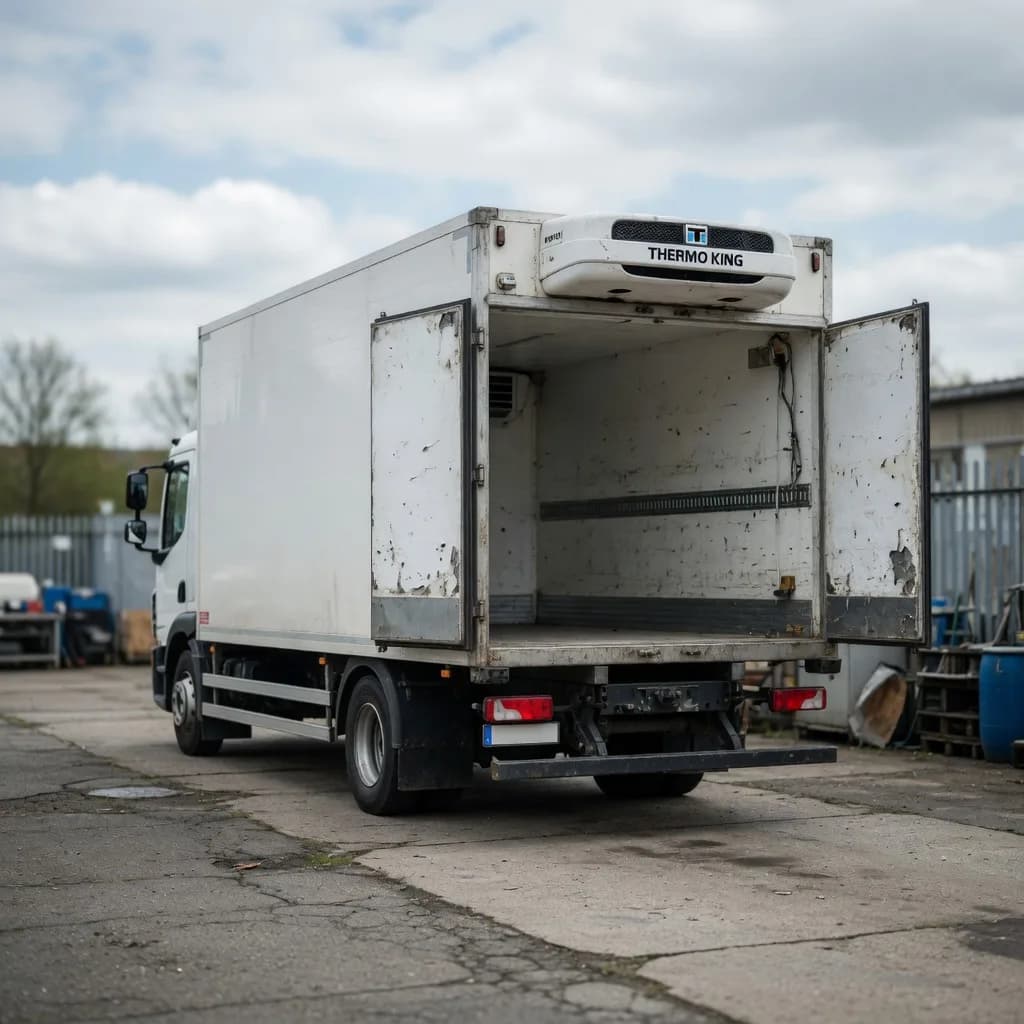
Accredited laboratory testing and certificates for refrigerated transport equipment.
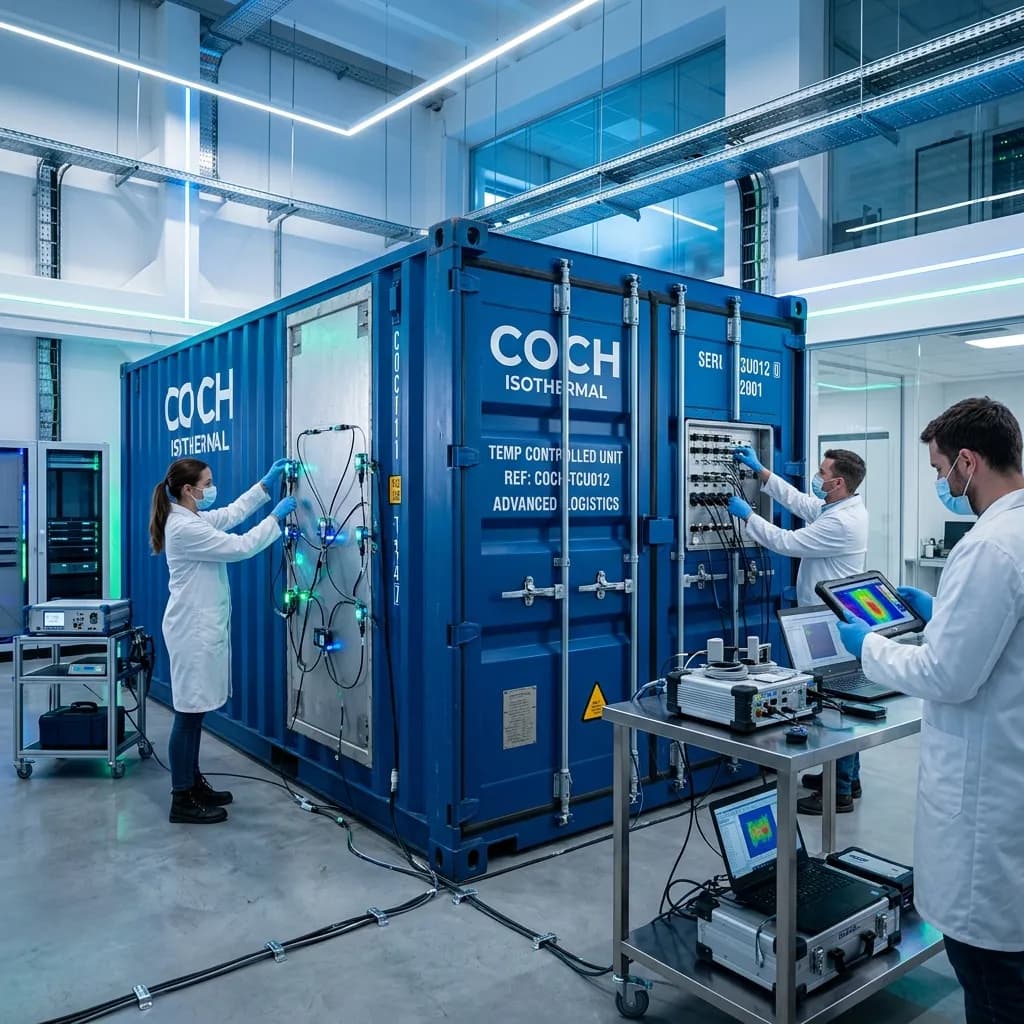
Thermal performance testing of isothermal and refrigerated containers.

Temperature distribution mapping for the pharmaceutical cold chain.

Production plant inspections under the ATP Agreement (AK 044).
Browse answers to the most frequently asked questions about the ATP Agreement, its provisions, and practical application in transport.
If you are unsure about the interpretation of the ATP Agreement regulations, our experts are here to help.
COCH Kraków is the only body in Poland authorised to issue ATP certificates. PCA accreditation AB 308 with ILAC MRA recognition guarantees that certificates and test reports are accepted in all ATP Agreement signatory countries.
ILAC MRAPCA · ILAC MRA · ACCREDITATION
The laboratory holds PCA accreditation with ILAC MRA international recognition. Certificates issued by COCH are mutually recognised by all signatory countries of the ATP Agreement worldwide.
Contact our specialists directly to arrange a test date or get technical advice.
Location & directions
Centralny Ośrodek Chłodnictwa „COCH”
ul. Juliusza Lea 116, 30-133 Kraków
Mon – Fri: 8:30 – 18:00
Entry via Gate No. 2 – dedicated for semi-trailers and TIR combinations.
Contact the laboratory for technical guidance — or see related ATP/FRC testing services above.
