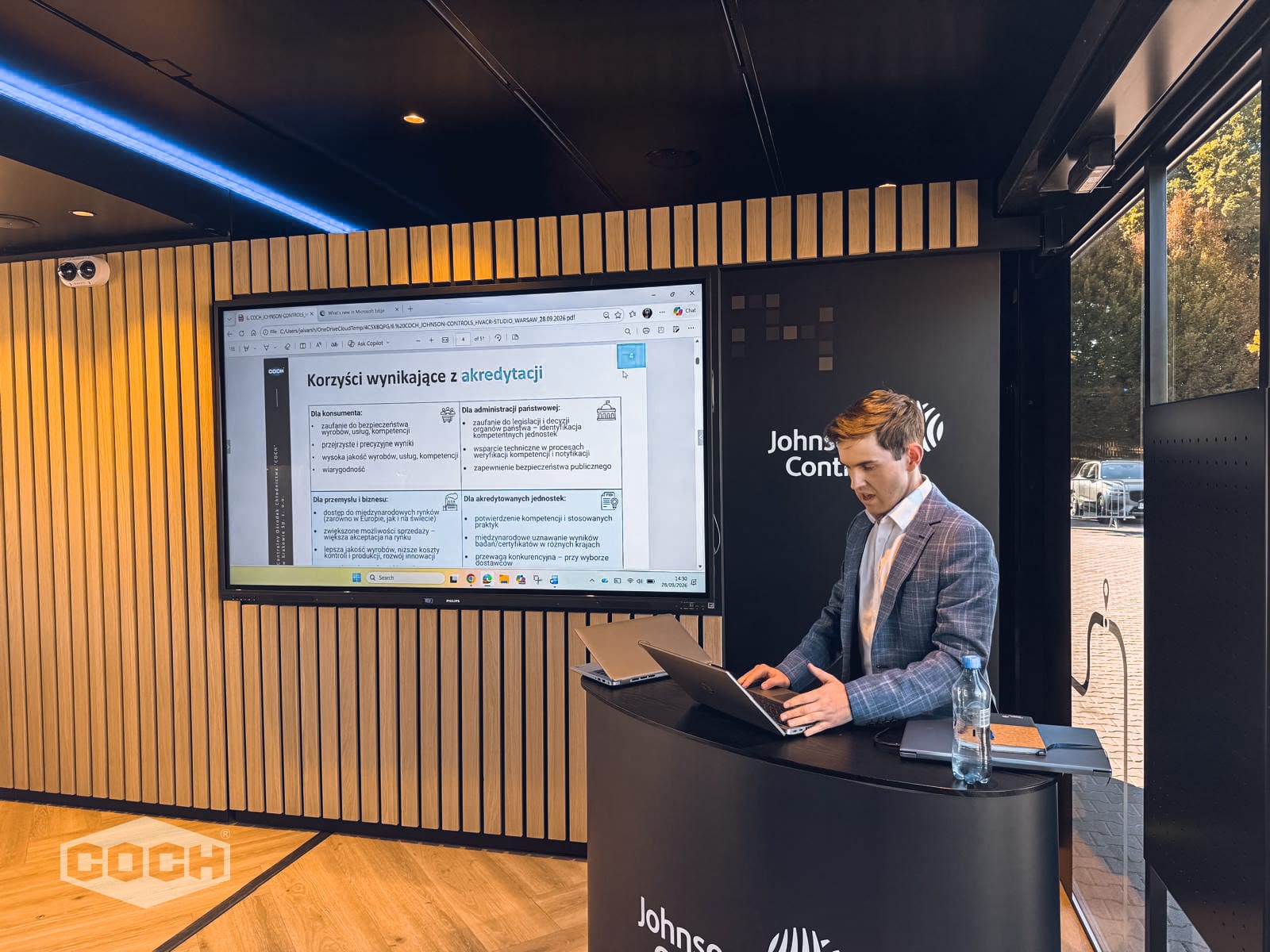
Interview with Bogdan Szczepański, Director for Research and Development at COCH Kraków – on the essentials of running a testing and certification organisation.
What element in running a business do you consider most essential?
The foundation of a modern company's success is competent personnel. In business practice and common understanding of concepts and terminology, the terms education, qualifications, and competences are very often and incorrectly used interchangeably. Competences are, unfortunately, very frequently equated with qualifications and defined as the ability to satisfactorily perform tasks required in a given profession. However, this appears to be a significant oversimplification that does not fully reflect the concept of competences. An apt illustration of what competence is and what it depends on is the so-called iceberg model. Knowledge, skills, experience - that which is visible - constitutes the tip protruding above water. Hidden are elements such as self-image, personality traits, social role, and finally motives - difficult-to-discern factors which, combined with the aforementioned, determine whether an employee is regarded as competent. The dream of every manager is to have the largest possible number of competent employees. Competent personnel means high-quality work and minimisation of risks.And what types of risks occur in the field of refrigeration and air conditioning?
The widespread use of refrigeration, air conditioning equipment, and heat pumps across a range of areas of life, from industry through commercial and service activities to households, is associated with various risks typical of the operation and use of equipment and installations, but also risks to the natural environment. These risks are primarily linked to the physical and chemical properties of refrigerants, including fluorinated greenhouse gases (F-gases) and ozone-depleting substances (ODS), as well as the operation of equipment and installations. Refrigerants, their mixtures, and compounds with oils, water, or other materials present in the refrigeration system interact physically and/or chemically from the inside on the materials of the components enclosing them in the circuit. These agents are characterised by hazardous properties and, upon escaping from the refrigeration system into the surroundings, may pose a threat to persons, property, and the natural environment both directly and indirectly through long-term global impact. Potential risks resulting from the release of refrigerants into the surroundings include, for example: fire, explosion, toxic action, asphyxiation due to oxygen deficiency, as well as degradation of the ozone layer surrounding the Earth and the greenhouse effect. Hearing damage due to excessive noise or damage due to vibrations may also occur as a result of machinery properties and unskilled operation by personnel. Such a state of affairs requires that persons involved in the design, construction, production, assembly and installation, operation, maintenance and repair, and decommissioning of refrigeration equipment and installations possess appropriate qualifications guaranteeing that activities performed by them in this scope and the execution of required tasks will involve conscious compliance with all requirements aimed at ensuring the safety of persons and property as well as broadly understood protection of the natural environment, including energy efficiency. Possession of such qualifications means that a given person is competent within a defined scope and, consequently, authorised to perform specific tasks.
How to verify, measure, or assess the level of competences held by personnel?
The simplest method is confirmation of competence by an independent body through the conduct of certification and issuance of an appropriate document - a certificate. COCH in Krakow has within its structure an accredited certification body for persons operating in accordance with the requirements of standard PN-EN ISO/IEC 17024 "Conformity assessment. General requirements for bodies operating certification of persons" and, as an accredited certification body (PCA Accreditation), conducts certification of specialists' competence in the field of refrigeration, air conditioning, and heat pumps within the scope defined by standard PN-EN 13313 "Refrigerating systems and heat pumps. Competence of personnel". In accordance with the adopted certification programme and the requirements of the standard, it issues certificates for four levels of competence:- Basic Level BA (Basic Appreciation) - level of knowledge and experience required to discuss main elements of skills with others. Scope of activities: leak checking, refrigerant recovery, and activities within the scope of tasks indicated in standard PN-EN 13313:2011 - Annex A.
- Intermediate Level WK (Working Knowledge) - level of knowledge and experience required for direct participation in decisions and activities. Scope of activities: leak checking, refrigerant recovery, commissioning, operational inspection, operation, suspension of operation, and activities within the scope of tasks indicated in standard PN-EN 13313:2011 - Annex A and Annex B (electrical installations).
- Advanced Level FO (Fully Operational) - level of knowledge and experience required for personal execution of most activities. Scope of activities: leak checking, commissioning, operational inspection, operation, suspension of operation, assembly, prefabrication, acceptance, general maintenance, circuit maintenance, dismantling, refrigerant recovery, and activities within the scope of tasks indicated in standard PN-EN 13313:2011 - Annex A and Annex B (electrical installations).
- Specialist Level LE (Leading Edge) - level of knowledge and experience required for significant development of the skills area. Scope of activities: design and activities within the scope of tasks indicated in standard PN-EN 13313:2011 - Annex A.
What does accreditation of the certification body provide?
Accreditation is the assurance of the conduct of certification activities by entities (certification bodies) in accordance with the requirements of legal regulations and normative documents, continuous supervision over certification bodies, stimulation of raising the level of competence and quality in the activities conducted by these bodies. Accreditation ensures:- High level of quality of certification services provided
- Impartiality - already at the level of the certification body (necessity to ensure participation of all interested parties in the implementation of the body's policy), eliminating the need to appoint "central" expert teams for this purpose.
- Independence - guaranteed at the level of the certification body, confirmed on a continuous and supervised basis during surveillance audits within the framework of supervision over the certification body's accreditation certificate.
- Accessibility - for all interested parties.

Rate this article
Be the first to rate this article!